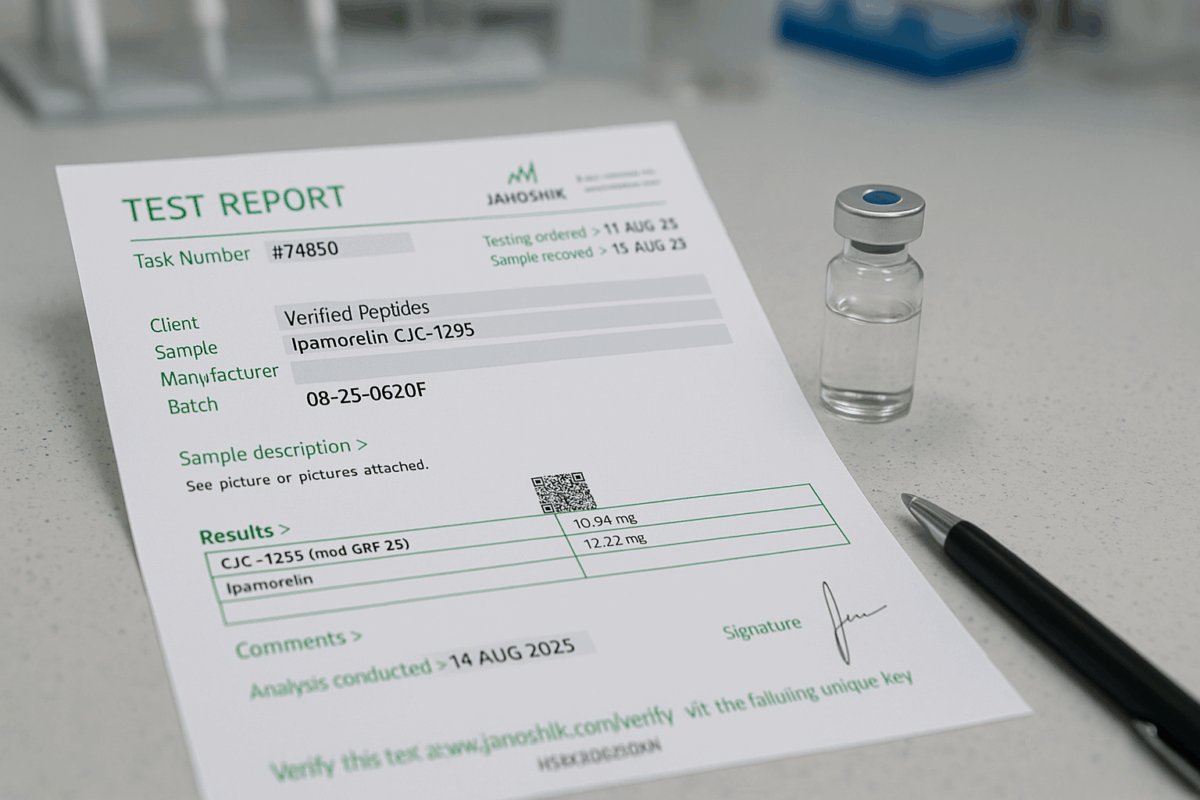
Understanding Peptide Purity: What 99% Really Indicates
Comprehending Peptide Pureness: What 99% Actually Indicates Picking peptides with validated 99%+ pureness means choosing precision, reliability, and honesty in your job. Legitimate UK providers ought to just sell peptides for Research Usage Just (RUO), sticking strictly to UK policies. Beware of providers who make unapproved restorative insurance claims or offer peptides for human usage.
What The Purity Percent In Fact Implies
Authentic study peptides come with a Certification of Analysis showing HPLC pureness testing and mass spectrometry results from an independent lab. You can verify authenticity by inspecting the COA verification code through the screening research laboratory's site. Regular pureness degrees vary in between 99.0% and 99.7%, lining up with global lab study standards. These tests confirm that peptides from Peptides Lab UK include no pollutants, destruction spin-offs, or unwanted fillers-- simply confirmed, high-purity research product. Natural peptide synthesis starts with the transcription of DNA into carrier RNA (mRNA). After that, ribosomes check out the mRNA and trigger amino acids to fuse in a polypeptide chain, adhering to a series with desired physical effects.
What is considered high pureness?
Gases that have really reduced levels of contaminations are high-purity gases. They are fine-tuned to be composed nearly completely of the designated gas molecules. The degree of pureness of these gases is typically above 99.995% and get more info can exceed 99.99999%. These gases are rated based on the number of 9s in the pureness level.
Peptides are billed particles at many pH worths and the presence of different counterions will influence their chromatographic behavior. Therefore, anionic counterions (e.g.,, phosphate) will certainly engage with the protonated standard (i.e., favorably charged) residues of a peptide. In comparison, a cationic counterion (e.g., trimethylammonium, triethylammonium, tetrabutylammonium) will show an affinity for ionized carboxyl (i.e., negatively charged) teams. Recently, we established the optimal TFA focus for peptide splittings up to be 0.2-- 0.25% TFA, significantly higher than the typically employed concentration series of 0.05-- 0.1% (71 ). Precise dosing depends upon the concentration of active peptides in your sample. If the pureness is off, your peptide's effectiveness might be compromised, leading to wrong dosing that impacts the credibility of your experiments. In this write-up, we'll study why peptide purity issues, what 99%+ purity really suggests, and how partnering with a trusted UK peptide supplier like CK Peptides can raise your research outcomes. Yet scientists didn't create peptide synthesis; they simply discovered a means to do it in a controlled and reproducible fashion. As a matter of fact, peptide synthesis occurs normally in living organisms, where peptides play essential roles in various biological processes. The area of custom-made peptide synthesis has seen exceptional progress because Advanced ChemTech's starting in 1985. Peptides have become one of the most essential biological sensations for establishing novel therapeutics. Peptides Will Not Change Medical TreatmentIf you have a significant clinical condition, peptides are not substitutes for proper diagnosis and treatment. Every peptide comes from suppliers who adhere to Great Manufacturing Practices (GMP) and send to third-party screening.
Various other spectroscopic strategies, such as Infrared (IR) or UV-Vis analysis, are sometimes made use of for rapid high quality checks or structural confirmation.Peptide purity screening refers to logical procedures used to assess the composition of a peptide sample.A peptide listed as 99% pure by HPLC contains 1% pollutants by UV-detected location.It needs to help you value the significance of peptides in pharmaceutical studies.On top of that, the aromatic side-chains of tyrosine, phenylalanine and tryptophan take in light in the 250-- 290 nm UV range; it should be noted, nevertheless, that these fragrant deposits are not present in all peptides.Trustworthy research study peptide suppliers either manufacture to pharmaceutical-grade analytical standards (with validated internal capabilities) or make use of third-party testing, or both.
Which Peptides Are Secure? A Guide To Top Quality Requirements
This batch-to-batch verification provides quality control across time and makes certain researchers have documentary proof for each and every order they put. All peptides sold by Peptides Lab UK are purely for research laboratory study functions just. They are not intended for human usage, clinical use, or cosmetic application. Supports boosted muscle advancement, increased stamina, and boosted recuperation-- especially investigated for muscle-wasting problems and efficiency improvement. Costs 95% pureness formulation makes sure consistency and integrity. At Aspire Rejuvenation Center, we take peptide safety and security very seriously.
Preparative Hplc Of Synthetic Peptides And Recombinant Healthy Proteins
CE, particularly Research Material Supply capillary area electrophoresis (CZE), manipulates analyte charge or, much more precisely, the mass-to-charge ratio. Peptide purity 95 vs 98 is a crucial decision for B2B research study, cosmetic and growth projects. Serox GmbH in Mannheim, Germany assists professional customers specify an appropriate pureness spec based upon intended usage, called for documents and project sensitivity. Lyophilised peptides need to be stored at -20 ° C or chillier, secured from dampness and light. As soon as reconstituted in remedy, peptides are more prone to degradation with oxidation, deamidation, and temperature fluctuations. Column, problems of preparative RP-HPLC and portion analysis, and peptide sequence explained under Subheading3.6.1. Analytical reversed-phase high-performance liquid chromatography profile of crude artificial 26-residue amphipathic -helical antimicrobial peptide. A, On-scale elution profile; B, fourfold expansion of elution profile. Size-exclusion chromatography evaluation of oligomerization states of peptides. A, B, elution accounts of peptides; C, relationship between Log molecular weight of eluted species and their retention times. Approach validation makes certain that HPLC results accurately show peptide pureness. Personalized peptide synthesis merely suggests synthesizing a certain series of amino acids, generally for study or industrial objectives. SPPS is one of the most typically utilized approach due to its performance, cost-effectiveness, and convenience. High-Performance Liquid Chromatography (HPLC) is the basic technique for quantifying peptide pureness. It divides the target peptide from peptide-related contaminations (removal series, truncated pieces, and synthesis by-products). HPLC (high-performance liquid chromatography) is the standard analytical strategy for gauging peptide pureness.